Circular catalyst lifecycle solutions
EURECAT provides a complete range of solutions to extend catalyst use, restore performance, and recover value from spent catalysts. From regeneration and rejuvenation to repurposing, reshaping and metal recovery, our expertise helps customers make informed decisions at every stage of the catalyst lifecycle.
Reuse when possible. Recover when necessary. Maximize value throughout the catalyst lifecycle.
EURECAT'S RECYCLING SOLUTION
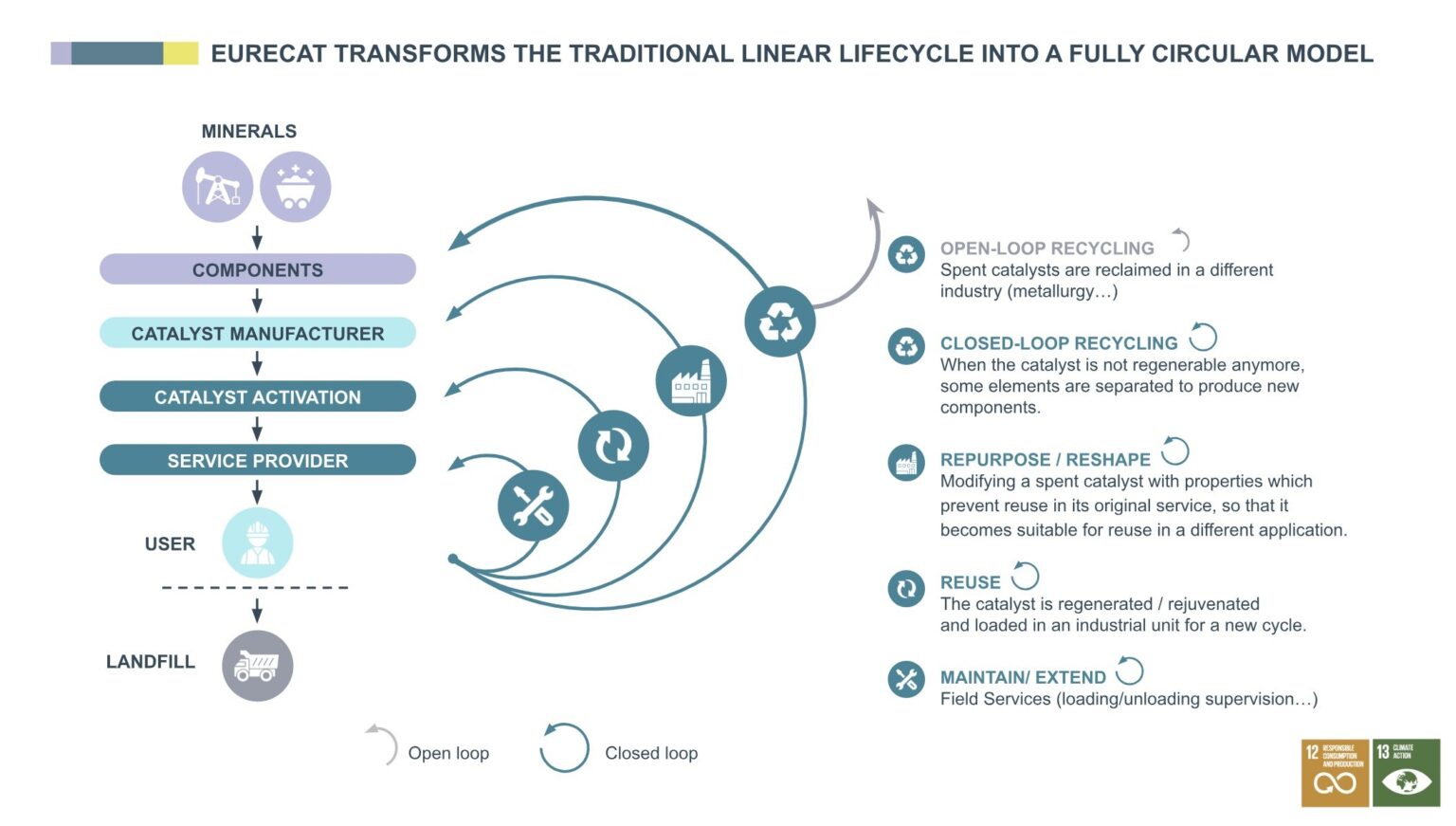
Maximizing value from spent refinery catalysts through closed-loop and open-Loop recycling pathways
Refineries generate significant volumes of spent hydroprocessing catalysts containing strategic metals such as Nickel, Molybdenum, Cobalt, and Tungsten. Managing these materials responsibly is essential to reduce environmental impact, ensure regulatory compliance, and recover valuable resources.
With extensive expertise in catalyst sampling, characterization, logistics, waste management, and metal recovery processes, EURECAT identifies the most suitable recycling pathway for each catalyst batch, maximizing both resource recovery and economic value.
Key benefits
- Recovery of valuable strategic metals from spent catalysts.
- Reduction of hazardous waste and landfill disposal.
- Full regulatory compliance throughout the recycling chain.
- Improved sustainability and circular economy performance.
- Optimized value generation from spent catalyst inventories.
CLOSED-LOOP & OPEN-LOOP RECYCLING
CLOSED-LOOP RECYCLING
Turning Spent Catalysts into New Catalysts
Closed-loop recycling enables critical metals recovered from spent catalysts to be refined and reintroduced into the manufacture of new catalyst products, supporting a truly circular value chain.
Benefits
Direct Reintegration into Catalyst Manufacturing
Recovered Nickel, Molybdenum, Cobalt, and Tungsten are processed and reused as raw materials for the production of new catalysts.
Quality and Traceability Assurance
Maintains the strict quality requirements and traceability standards necessary for hydroprocessing catalyst manufacturing.
Supply Chain Resilience
Reduces dependence on virgin raw materials while helping mitigate supply risks and price volatility.
Development Status
This solution is currently under development and represents the next step toward a fully circular catalyst value chain.
OPEN-LOOP RECYCLING
Cross-Industry Metal Valorization
Open-loop recycling, also known as cascade recycling, recovers metals from spent refinery catalysts and redirects them into industrial applications outside the refining and petrochemical sector.
Benefits
Alternative Industrial Applications
Recovered metals are transformed into products such as stainless-steel alloys, aerospace superalloys, pigments, and specialty chemicals.
Operational Flexibility
Provides an efficient recovery solution for catalyst batches whose characteristics or contamination levels do not meet the specifications required for catalyst-to-catalyst recycling.
Maximum Material Recovery
Ensures valuable metals remain in productive use while preventing spent catalyst disposal in landfill facilities.
REUSE - HPC Applications
Unlock the full value of your catalysts
Catalysts represent a valuable asset and should not be limited to a single operating cycle.
In a circular economy, reuse is one of the most effective ways to reduce costs, minimize environmental impact, and maximize asset value.
For hydroprocessing catalysts, multiple reuse cycles can deliver substantial savings compared to continuous replacement with fresh catalyst, while significantly reducing waste and CO₂ emissions.
At EURECAT, we help refiners implement catalyst reuse strategies with confidence. Through advanced regeneration and rejuvenation solutions, we restore catalyst performance while ensuring compliance with unit requirements and operational objectives.
Why reuse catalysts?
- Lower catalyst procurement costs.
- Reduced environmental footprint.
- Extended catalyst life cycle.
- Performance validated through testing and field experience.
- Proven and widely adopted by refiners worldwide.
- Supported by catalyst manufacturers and licensors.
Whether through regeneration or rejuvenation, EURECAT provides tailored solutions to help customers recover maximum value from their spent catalysts.
CATALYST REGENERATION
Catalyst qualification for REUSE
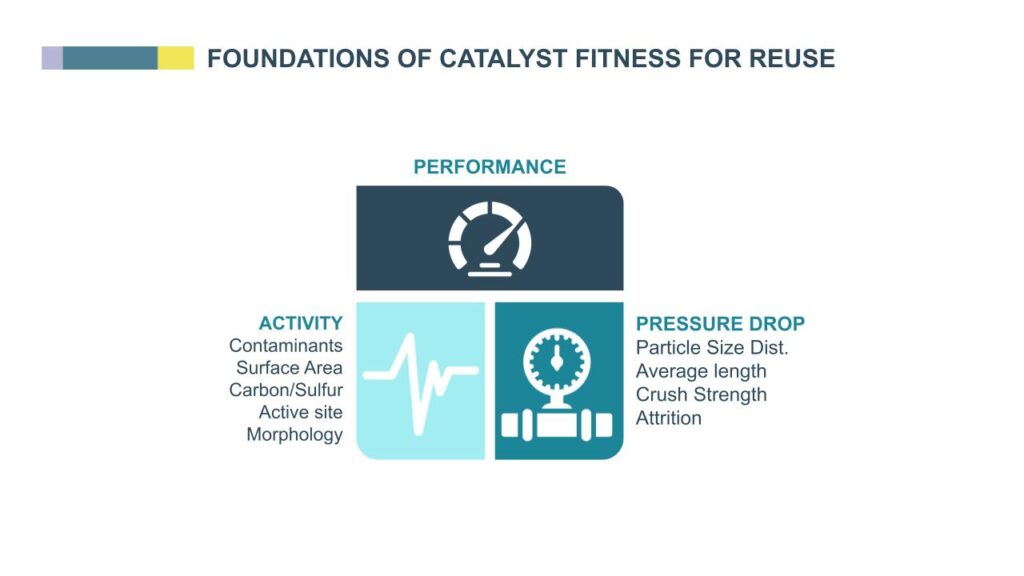
A detailed spent catalyst evaluation is essential to ensure that only catalyst with the right activity potential and mechanical integrity is selected for the next cycle. Our objective is not simply to regenerate catalyst, but to qualify the catalyst that can safely deliver performance as close as possible to fresh material.
Our evaluation combines:
- Chemical analysis to identify contaminant levels and deactivation mechanisms.
- Physical characterization to verify surface area and particle integrity.
- Mechanical testing to assess crush strength, fines generation and pressure drop behavior.
- Pilot plant activity testing to validate expected performance after regeneration or rejuvenation.
Thanks to EURECAT’s expertise:
- Reusable catalyst is identified and segregated from unsuitable material.
- Catalyst recovery is maximized while protecting future unit performance.
- Customers receive a technically validated catalyst capable of achieving activity and operating characteristics close to fresh catalyst.
In short, our qualification process transforms spent catalyst into a reliable and validated product for the next run, minimizing risk and maximizing value for the customer.
Restoring activity through controlled regeneration
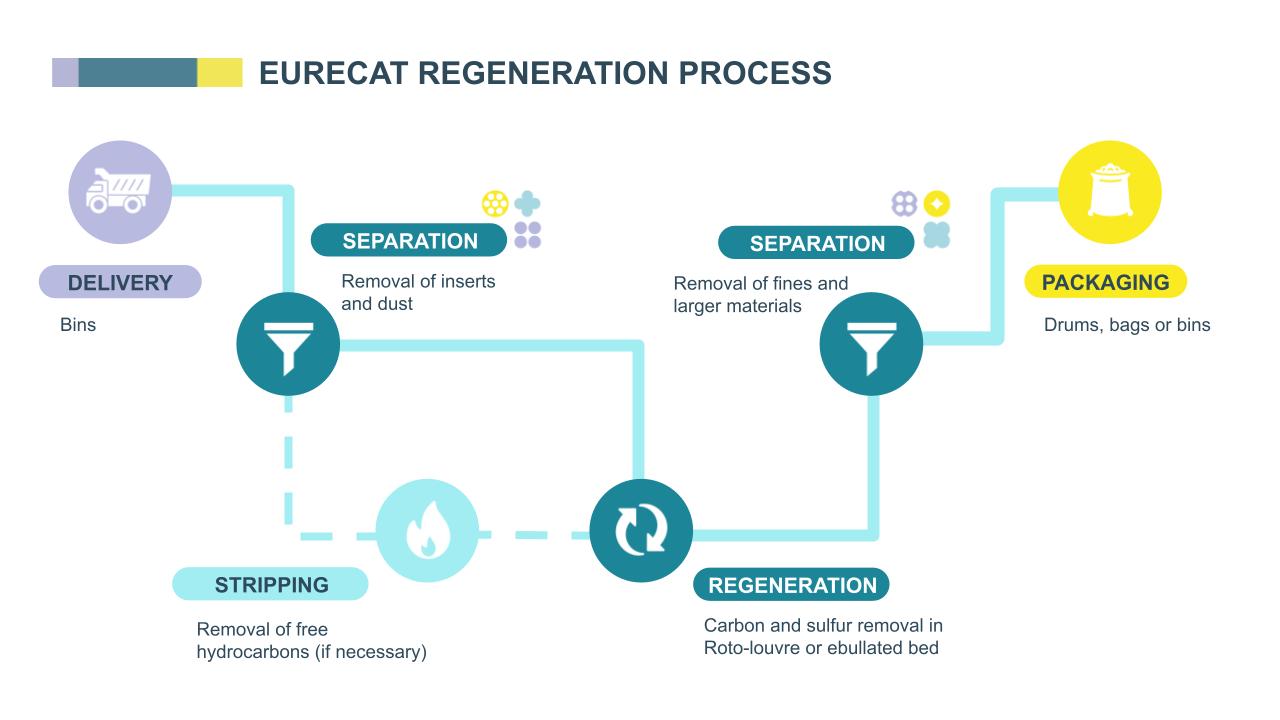
Catalyst regeneration is the first step in catalyst reuse. The process removes carbon and sulfur deposits accumulated during operation, restoring activity to catalysts that have reached the end of their cycle.
Achieving the highest possible activity recovery requires precise control of regeneration conditions. Excessive temperatures can reduce catalyst performance through surface area loss and active metal agglomeration, while insufficient treatment may leave contaminants behind.
EURECAT’s regeneration process is designed to optimize this balance, ensuring effective contaminant removal while preserving catalyst integrity.
Benefits of Regeneration
- Controlled removal of carbon and sulfur deposits.
- Preservation of catalyst physical properties.
- Optimized activity recovery.
- Reduced replacement costs.
- Sustainable alternative to catalyst disposal.
Typical Activity Recovery (after regeneration only)
- Type I catalysts: 85-95% activity recovery.
- Type II catalysts: 50-70% activity recovery.
Every catalyst requires a tailored regeneration approach. EURECAT’s expertise ensures that operating conditions are adapted to each catalyst type to maximize recovered performance and prepare the material for redeployment or further rejuvenation.
CATALYST REJUVENATION
Bringing catalysts back to near-fresh performance
Catalyst rejuvenation extends catalyst life well beyond conventional regeneration by restoring lost activity and significantly improving performance. The result is a cost-effective and environmentally responsible alternative to replacing catalyst with fresh material.
EURECAT has more than two decades of experience in hydroprocessing catalyst rejuvenation and has successfully processed over 50,000 tons of catalyst for hundreds of operating units worldwide.
Key Advantages
- Restore near-fresh catalyst performance.
- Reduce catalyst replacement costs.
- Extend catalyst life cycles.
- Lower CO₂ emissions compared to fresh catalyst.
- Proven performance through pilot plant validation.
Rejuvenation can recover:
- More than 90% Relative Volume Activity (RVA) for Type II catalysts
- More than 100% RVA for Type I catalysts
EBoost™ Rejuvenation technology
EURECAT's Proprietary Solution for Maximum Catalyst Reuse
EBoost™ is EURECAT’s proprietary catalyst rejuvenation technology, developed to maximize catalyst activity while extending catalyst life and improving sustainability.
The technology delivers activity levels close to fresh catalyst and, in certain cases, can even exceed original fresh catalyst performance.
EBoost™ Benefits
- Applicable to both Type I and Type II catalysts.
- Compatible with most catalyst technologies and manufacturers.
- Excellent yield retention and catalyst strength characteristics.
- Seamless integration into EURECAT's complete reuse strategy.
Maximizing Catalyst Value
EBoost™ helps refiners extract the maximum value from their spent catalysts:
- Restore Type II catalysts to near-fresh activity levels.
- Upgrade Type I catalysts beyond their original fresh performance.
- Extend catalyst life and defer replacement costs.
- Support circular economy objectives through advanced catalyst reuse.
Why Choose EBoost™?
EBoost™ provides refiners with an economical pathway to maximize catalyst reutilization while reducing operational costs and environmental impact.
With EURECAT managing the entire process, customers benefit from simplified logistics and a single trusted partner for:
- Catalyst segregation.
- Regeneration.
- Rejuvenation.
- Reclaim services when required.
Compared to fresh catalyst manufacturing, EBoost™ can reduce associated CO₂ emissions by more than 60%, while delivering the activity needed to support refinery performance objectives.
Licensed catalyst manufacturers rejuvenation
EURECAT is also licensed by leading catalyst manufacturers, including Axens, Ketjen, Shell Catalysts & Technologies and Sinopec, to implement proprietary rejuvenation technologies such as REVIVAL®, REACT® and ENCORE™. This broad technology portfolio allows customers to access trusted, validated solutions tailored to a wide range of catalyst platforms and performance requirements.
REUSE - Petrochemicals Applications
Unlock more value from your specialty catalysts
Specialty catalysts are valuable assets that should not be limited to a single operating cycle.
Through regeneration and reactivation solutions, EURECAT helps petrochemical producers restore catalyst performance, extend catalyst life, reduce costs, and minimize environmental impact.
Why reuse specialty catalysts?
- Lower catalyst replacement costs.
- Reduced environmental footprint.
- Extended catalyst life.
- Preservation of valuable active metals.
- Proven industrial performance.
Aromatics process catalysts
Proven Regeneration for Zeolite Catalysts
Supported by catalyst manufacturers and licensors, EURECAT regenerates zeolite-based catalysts used in:
- Benzene alkylation (EB and Cumene).
- Toluene transalkylation and disproportionation.
- Xylene isomerization.
Key benefits
- Reduced catalyst costs.
- Extended catalyst life cycle.
- Lower environmental impact.
- Proven worldwide performance.
RAISE™
Reactivation technology for palladium catalysts
Restore Activity. Recover Selectivity. Extend Catalyst Value.
Palladium is extremely expensive, and palladium catalysts are no exception. While both ex situ and in situ regeneration can be challenging, there is a way to fully recover catalyst performance.
RAISE™ (Recover Activity and Improve Selectivity Evaluation) is EURECAT’s proprietary catalyst reactivation technology for palladium-based hydrogenation catalysts.
By combining deep carbon removal with advanced contamination assessment, RAISE™ restores catalyst performance while preserving the active palladium phase and catalyst integrity.
The technology minimizes active phase agglomeration and sintering, improves selectivity, and helps identify and separate certain catalyst poisons that may affect long-term performance.
Key benefits
- Deep carbon removal with minimal sintering.
- Preservation of palladium dispersion.
- Enhanced catalyst selectivity.
- Reduced runaway risks during operation.
- Partial removal of catalyst contaminants.
- No catalyst breakage.
- Less than 1% fines generation.
- No palladium loss.
- Extended catalyst life and reduced replacement costs.
Proven performance
- More than 160 successful campaigns
- More than 2,400 tons processed
- Zero reported failures
Typical applications
- C2 Selective Hydrogenation
- C2/C3 Selective Hydrogenation
- C3 Hydrogenation
- C4/C5 Hydrogenation
- Pygas Hydrogenation
- Hydro-Isomerization
- FCC Light Olefin Recovery
- General Pd Hydrogenation Processes
Why choose RAISE™?
Unlike conventional regeneration processes, RAISE™ is specifically designed to restore both activity and selectivity while protecting palladium dispersion and catalyst integrity.
When combined with REDUCAT™, RAISE™ delivers a ready-to-use catalyst capable of returning to service rapidly and reliably.
Recover performance. Preserve precious metals. Extend catalyst life.
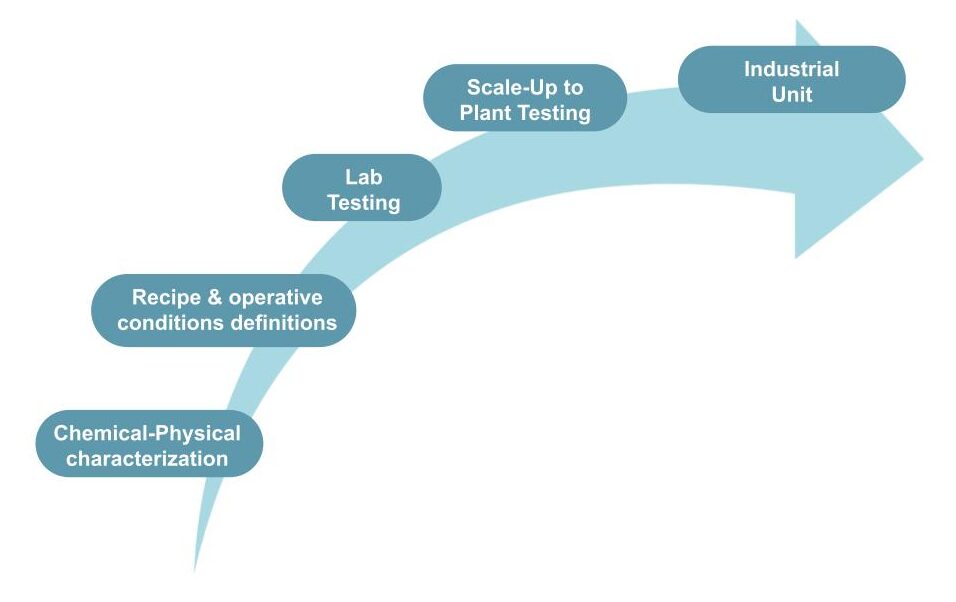
New catalyst qualification & development studies
From laboratory evaluation to industrial scale-up
For catalyst types not yet covered by EURECAT’s commercial reuse portfolio, dedicated R&D studies can be performed to assess reuse potential and develop customized regeneration or reactivation process.
Services Include
- Chemical characterization
- Deactivation mechanism assessment
- Laboratory regeneration studies
- Reactivation process development
- Pilot-scale validation
- Industrial scale-up support
Transform catalyst reuse opportunities into validated industrial solutions.